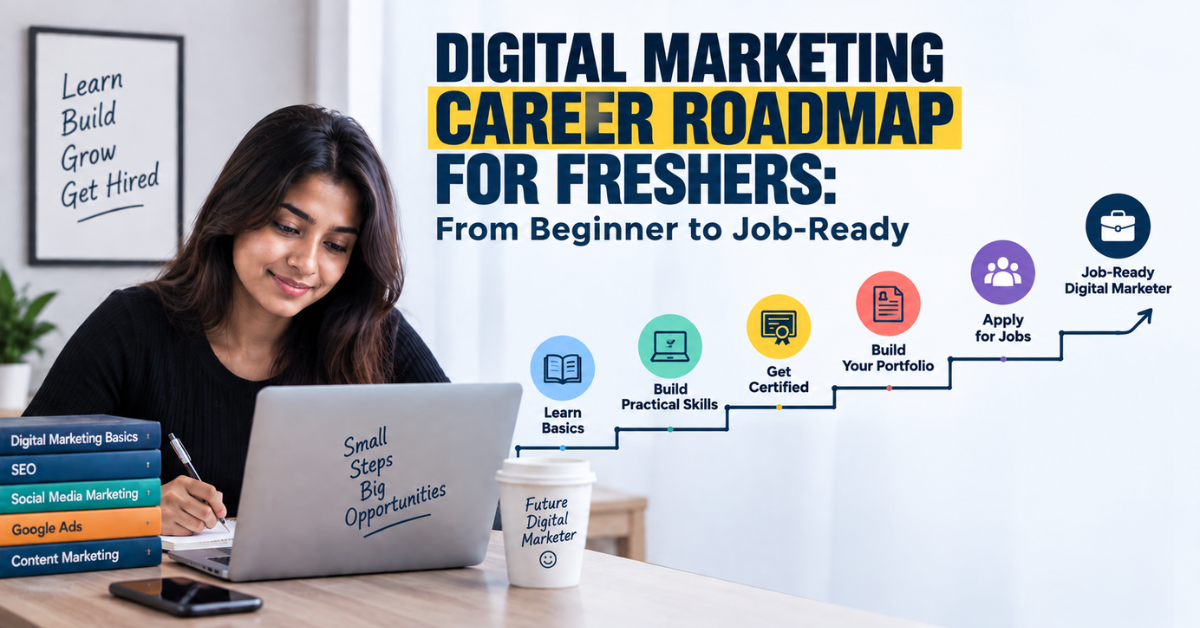
A fresher can start a digital marketing career in Thane by following a structured path:
Understand marketing → Learn digital channels → Practise → Build projects → Create a portfolio → Develop communication skills → Prepare for interviews → Apply for entry-level roles → Keep specializing.
You do not need to master every digital marketing discipline before applying for your first job after a digital marketing course in Thane.
The goal is to become useful enough to contribute to a marketing team.
Step 1: Understand What Digital Marketing Actually Is?
Don’t begin by memorizing tool names.
First understand the basic objective:
Find the right audience → Attract attention → Generate interest → Drive action → Measure results → Improve performance
Digital channels are methods of achieving those objectives.
Step 2: Learn the Major Digital Marketing Channels
A beginner should understand:
SEO
How websites gain organic visibility.
Paid Advertising
How businesses pay to reach relevant audiences.
Social Media
How brands communicate and build communities.
Content Marketing
How useful information attracts and educates audiences.
Email Marketing
How businesses communicate directly with subscribers and customers.
Analytics
How marketers measure behavior and results.
Step 3: Learn One Channel Deeply
After understanding the ecosystem, choose an area to develop deeper expertise.
For example:
SEO
or
Performance Marketing
or
Social Media
or
Content Marketing
or
Analytics
You don’t need to decide your permanent career immediately.
Your first specialization simply gives you direction.
Step 4: Learn the Tools
Depending on your chosen area, become familiar with relevant platforms.
For SEO:
- Google Search Console
- Google Analytics
- Keyword research tools
- SEO auditing tools
For paid advertising:
- Google Ads
- Meta Ads Manager
- Keyword Planner
- Analytics
For websites:
- WordPress
- Elementor
- Analytics
- Basic SEO tools
For content/social media:
- Canva
- Social platforms
- AI-assisted content tools
- Analytics
Step 5: Start Practising
This is where many beginners stop too early.
Watching 50 hours of videos does not create practical experience.
Start doing.
For example:
SEO exercise
Choose a website and perform a basic SEO audit.
Content exercise
Select a topic and create a search-focused content brief.
Google Ads exercise
Create a hypothetical campaign structure for a local business.
Meta Ads exercise
Develop a campaign plan for a course or service.
Social media exercise
Create a 30-day content strategy.
Website exercise
Build a basic WordPress business website.
Step 6: Document Your Work
Don’t just complete assignments.
Document them.
For each project record:
Objective
What were you trying to achieve?
Research
What information did you collect?
Strategy
What approach did you choose?
Implementation
What did you actually do?
Result
What happened?
Learning
What would you improve?
This turns an assignment into a portfolio case study.
Step 7: Build Your Digital Marketing Portfolio
A fresher doesn’t need 50 projects.
Start with 4–6 strong projects.
For example:
- SEO audit
- Keyword research project
- Content marketing project
- Google Ads campaign plan
- Meta Ads campaign plan
- WordPress website
Quality matters more than quantity.
Step 8: Learn Marketing Metrics
Before attending interviews, understand common metrics.
SEO
- Impressions
- Clicks
- CTR
- Ranking position
Paid Advertising
- CPC
- CPM
- CTR
- CPL
- CPA
- ROAS
Social Media
- Reach
- Engagement
- Views
- Saves
- Shares
- Follower growth
Website
- Traffic
- Engagement
- Conversion
- Leads
More importantly, understand what these numbers mean.
Step 9: Learn AI-Assisted Marketing
Freshers should understand how AI can improve productivity.
Use AI for:
- Research assistance
- Brainstorming
- Content ideation
- Content briefs
- Ad-copy variations
- Analysis
- Reporting
- Repurposing
But don’t become dependent on AI.
Your interviewers may ask:
“Why did you choose this strategy?”
AI cannot answer that for you.
You need to understand your own decisions.
Step 10: Build a Professional Resume
Your resume should communicate:
Skills + Tools + Projects + Results + Education
Instead of writing:
“Completed Digital Marketing Course.”
Write:
“Completed practical SEO project involving keyword research, on-page optimization, technical audit and Search Console analysis.”
The second statement communicates a skill.
Step 11: Prepare for Digital Marketing Interviews
Common interview areas include:
SEO
What is search intent?
What is the difference between on-page and technical SEO?
How would you perform keyword research?
Google Ads
What is CPC?
How would you structure a search campaign?
What factors can affect campaign performance?
Social Media
How would you create a content strategy?
How would you measure social media success?
Analytics
What is conversion rate?
How would you investigate a sudden drop in traffic?
AI
How would you use AI in content marketing?
How do you verify AI-generated information?
Step 12: Develop Communication Skills
Digital marketing is not only technical.
You may need to communicate with:
- Managers
- Designers
- Developers
- Sales teams
- Clients
- Business owners
Learn to explain:
What happened → Why it happened → What you recommend → What should happen next
This communication structure can significantly improve your professional effectiveness.
Step 13: Apply for the Right Entry-Level Roles
Don’t search only for:
“Digital Marketing Manager.”
Look for roles such as:
- Digital Marketing Executive
- SEO Executive
- SEO Intern
- Social Media Executive
- Performance Marketing Executive
- Content Executive
- Digital Marketing Associate
- PPC Executive
- Marketing Executive
Your first job is about gaining professional experience.
Step 14: Continue Specializing
After gaining experience, choose a stronger specialization.
For example:
SEO → Technical SEO → SEO Strategy
or
Google Ads → Performance Marketing → Growth Marketing
or
Social Media → Paid Social → Social Strategy
or
Content → SEO Content → Content Strategy
Specialization can help you move from general execution toward higher-value responsibilities.
A Simple 6-Month Digital Marketing Career Roadmap
Month 1
Fundamentals
Learn digital marketing, audience research, funnels and major channels.
Month 2
SEO + Content
Learn keyword research, SEO fundamentals and content marketing.
Month 3
Social + Paid Media
Learn social media, Google Ads and Meta Ads fundamentals.
Month 4
Website + Analytics + AI
Build a website, understand analytics and develop AI-assisted workflows.
Month 5
Projects + Portfolio
Complete projects and document your work.
Month 6
Career Preparation
Finalise CV, practise interviews, improve communication and start applying.
This is a framework rather than a guaranteed timeline. Different learners will progress at different speeds.
What Should a Fresher Put in a Digital Marketing Portfolio?
A strong beginner portfolio could contain:
Project 1
SEO Audit
Project 2
Keyword Research
Project 3
Content Strategy
Project 4
Google Ads Campaign Plan
Project 5
Meta Ads Campaign Plan
Project 6
WordPress Website
Project 7
Analytics Report
You don’t need to claim that these projects generated real business revenue if they were educational exercises.
Be transparent.
A well-documented simulated project is better than an invented result.
What Makes a Fresher Job-Ready?
Job-readiness isn’t a single certificate.
A stronger definition is:
Knowledge + Practical Skills + Portfolio + Communication + Interview Readiness
If you can explain what you did, why you did it and what you learned, you are moving closer to professional readiness.
How Digital Drishya Can Help You?
Digital Drishya’s digital marketing training is designed for beginners, students, graduates, working professionals and career switchers.
The program covers:
SEO + Google Ads + Meta Ads + Social Media + Content + WordPress + Analytics + Performance Marketing + AI
Along with technical learning, students receive support around:
- Resume preparation
- Interview preparation
- Mock interviews
- Portfolio development
- Career guidance
- Placement assistance
Final Takeaway
You don’t need to know everything about digital marketing before starting your career.
You need to build a strong foundation, practise consistently, develop evidence of your skills and keep learning.
The roadmap is simple:
Learn → Practise → Build → Document → Present → Interview → Work → Specialize
That’s how a beginner can gradually move from learning digital marketing to building a professional career.
FAQs
Can a fresher get a digital marketing job?
Yes. Entry-level roles are available across SEO, social media, content, paid advertising and general digital marketing.
How long does it take to learn digital marketing?
The fundamentals can be learned within a structured course, but professional capability develops through continuous practice and real-world experience.
Do I need a degree for digital marketing?
A degree can be useful, but practical skills, communication, portfolio work and relevant experience also matter.
Can I learn digital marketing without experience?
Yes. Beginners can start through structured training, practical assignments and projects.
Should I learn all areas of digital marketing?
You should understand the broader ecosystem initially, then develop deeper expertise in one or two areas.
Starting your digital marketing journey in Thane? Explore Digital Drishya’s practical training program in Thane and build your roadmap from beginner to job-ready.